By Useeworld Tech Insights
Interactive whiteboards (IWBs) are evolving from basic display panels into intelligent, all‑in‑one collaboration hubs. Driven by AI, cloud, and next‑gen display tech, the sector is set for a 8.3% CAGR through 2030, reaching $11.2 billion (Business Research Insights). Below are the core technology trends defining the era.
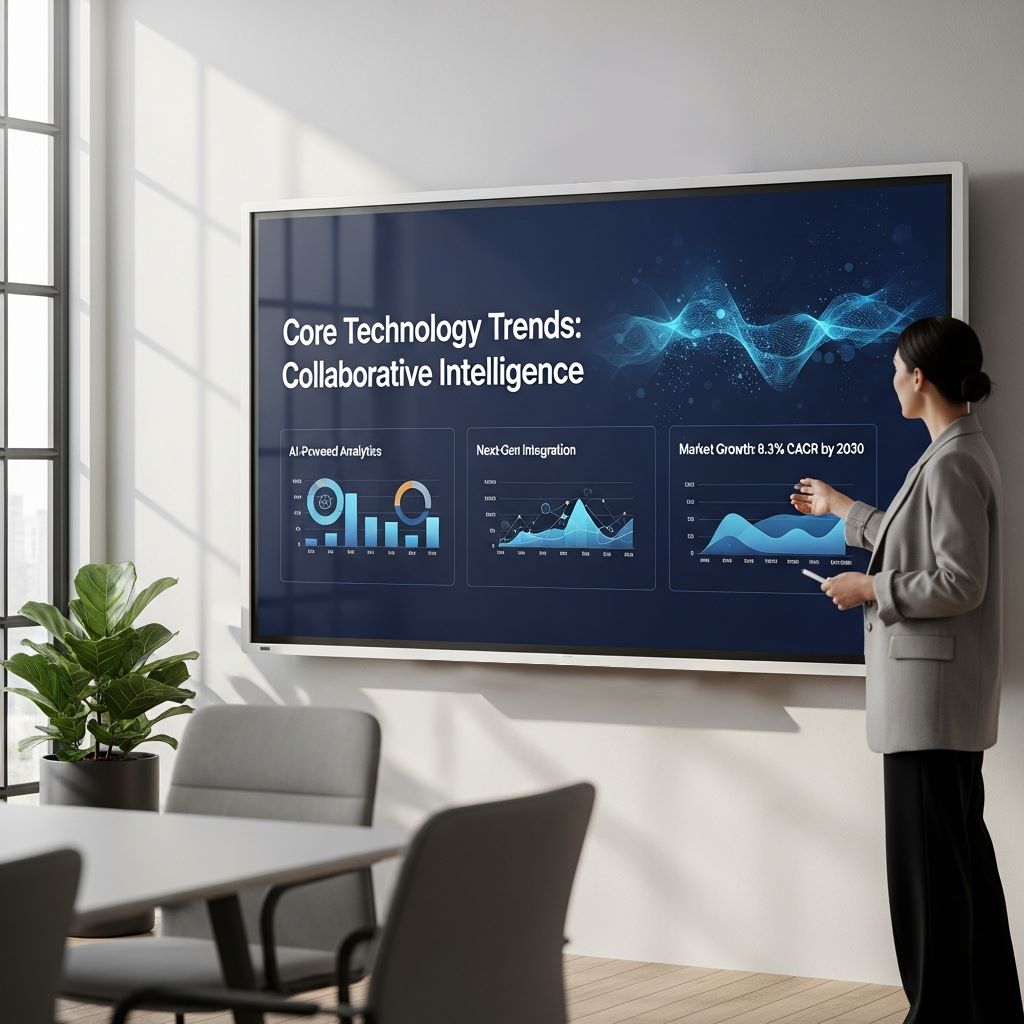
1. AI & Generative Intelligence: From Optional to Essential
AI is now a standard feature, not a premium add‑on. Modern IWBs integrate:
Smart handwriting recognition and real‑time multilingual translation
Generative AI for auto‑meeting summaries, lesson plan generation, and brainstorming aids
Voice control & NLP for touchless operation and content creation
AI analytics to track engagement, detect knowledge gaps, and suggest improvements
By 2027, over 70% of mid‑to‑high‑end IWBs will embed large language models (LLMs), turning devices into active cognitive hubs.
2. Cloud‑Native Ecosystems & Cross‑Device Collaboration
The industry is shifting from hardware sales to hardware–software–content–service models. Key advances:
Real‑time cloud sync for remote co‑editing and cross‑device access
Native integration with Microsoft 365, Google Workspace, Zoom, and LMS platforms
Centralized IoT device management for IT teams
Subscription‑based software revenue, expected to hit 25% of industry revenue by 2028
Cloud connectivity ensures seamless hybrid collaboration, bridging in‑person and remote participants.
3. Display Innovation: 4K, Mini‑LED & Large‑Format Dominance
Display tech remains a competitive frontier:
4K UHD is standard for professional IWBs; premium models adopt Mini‑LED/OLED for brighter, higher‑contrast visuals
75”–98” screens dominate boardrooms and classrooms; 98‑inch models grew 41% in 2026 (IDC)
Anti‑glare, low‑blue‑light, and adaptive brightness cut eye strain by 41% during long sessions
Micro LED is emerging in high‑end units, offering seamless splicing and superior visibility in bright environments
4. Touch & Interaction: Capacitive Multi‑Touch & Touchless Control
Interaction technology is becoming more intuitive and hygienic:
Capacitive multi‑touch dominates, enabling 10–20 point multi‑user writing and precise gesture control (pinch‑to‑zoom, swipe)
Infrared gesture sensing allows touchless operation from up to 3 meters, ideal for hygiene‑focused spaces (healthcare, education)
Active styluses with pressure sensitivity deliver natural writing and drawing experiences
5. Sustainability & Efficiency: Green Tech Goes Mainstream
Eco‑friendly design is a key purchasing criterion:
Energy‑efficient LED panels reduce power consumption by 35%
70% recycled aluminum casings and modular designs lower TCO by 25%
Paperless workflows cut school handout usage by 60% (UNESCO)
Long‑lifespan components and upgradable firmware extend device lifecycles
6. Security & Reliability for Enterprise & Education
As data sharing grows, security is non‑negotiable:
Encrypted data transmission and secure boot protect sensitive content
Multi‑user permission controls and role‑based access
Remote monitoring & maintenance reduce downtime for IT teams
Outlook: 2026–2030
The next five years will see IWBs evolve into proactive, context‑aware collaboration hubs. AI, cloud, and sustainable display tech will drive 70% of new feature development. As hybrid work and learning become permanent, manufacturers that unify intelligence, interoperability, and eco‑design will lead the global market.