Interactive Whiteboard Trends 2026–2030: The Future of Smart Collaboration
The interactive whiteboard (IWB) industry is evolving rapidly, driven by AI innovation, hybrid work and learning, and the demand for seamless digital collaboration. From basic touchscreens to AI-powered smart hubs, IWBs are redefining how we teach, meet, and create. Below are the key trends shaping the market through 2030.

1. AI & Generative Intelligence Become Standard
AI is no longer optional—it’s central to modern IWBs. In 2026, AI handwriting-to-text, real-time translation, voice control, and AIGC content generation are mainstream features. Premium models integrate large language models (LLMs) for instant summarization, brainstorming, and lesson plan creation. IDC reports that AI-equipped IWBs have 42% higher software subscription rates than traditional models.

2. Cloud & Ecosystem-Centric Design
The industry is shifting from hardware sales to “hardware+software+content+service” ecosystems. Cloud connectivity enables cross-device sync, remote collaboration, and centralized device management. Native integration with Google Workspace, Microsoft 365, and industry-specific platforms boosts productivity. By 2028, 25% of industry revenue will come from software and data services.
3. Advanced Display Tech: 4K, Mini-LED & Larger Sizes
4K UHD is standard for professional IWBs, with premium models adopting mini-LED/OLED for better brightness, contrast, and color accuracy.
Anti-glare coatings, low-blue-light filters, and adaptive brightness reduce eye strain by 41%.
75”–98” displays dominate: 98-inch models saw 41% adoption growth in 2026 for classrooms and boardrooms (IDC).
4. Hybrid Collaboration & Wireless Freedom
Hybrid work and learning are permanent, and IWBs are the backbone. Key features include:
Wireless screen casting from any device (no cables needed).
4K video conferencing with built-in cameras and microphones.
Real-time co-editing for remote teams, with cross-region collaboration up 33% in 2026.
5. Sustainable & Cost-Effective Engineering
Sustainability is a top purchasing priority:
Energy-efficient LED panels cut power use by 35%.
70% recycled aluminum casings and modular designs lower TCO by 25%.
Paperless workflows reduce school handout usage by 60% (UNESCO).
6. Enterprise & Vertical Market Expansion
While education remains the largest segment (60%+), corporate meeting rooms are the fastest-growing vertical. Demand is rising in healthcare (case discussions), retail (interactive kiosks), and smart cities (command centers). By 2030, the enterprise segment will account for 35% of total shipments.
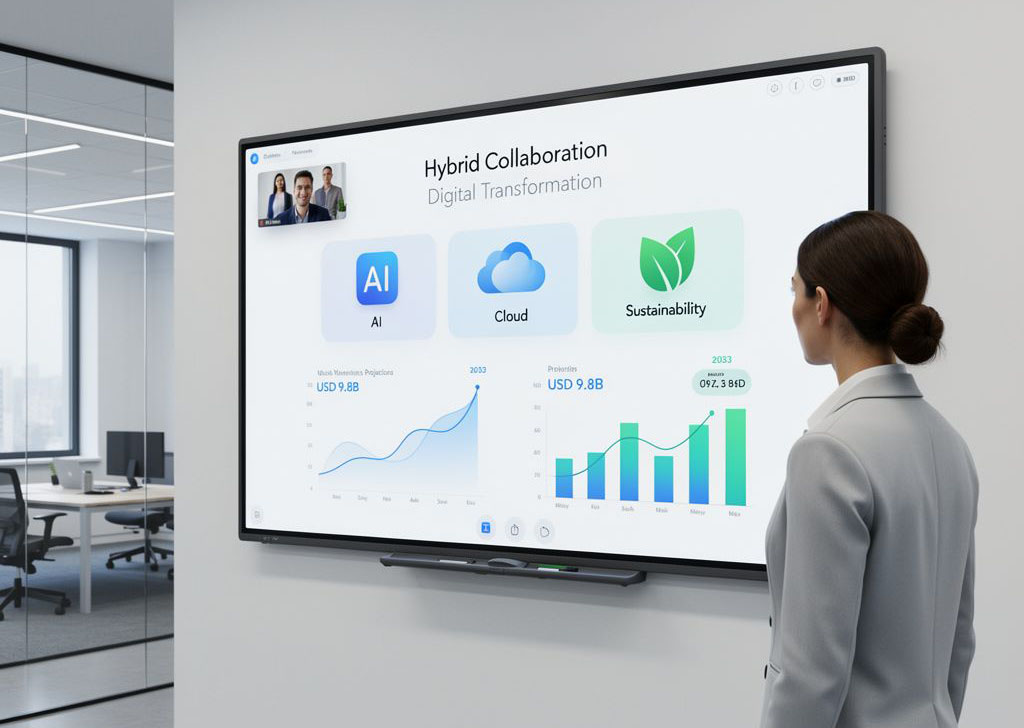
Outlook: 2026–2030
The global IWB market is projected to grow at a 7.5% CAGR, reaching USD 9.8 billion by 2033. AI, cloud, and sustainability will drive 70% of new feature adoption. As hybrid collaboration becomes universal, interactive whiteboards will remain essential tools for education and enterprise digital transformation.